
Types of Schema Markup in SEO: A Complete Guide for 2026
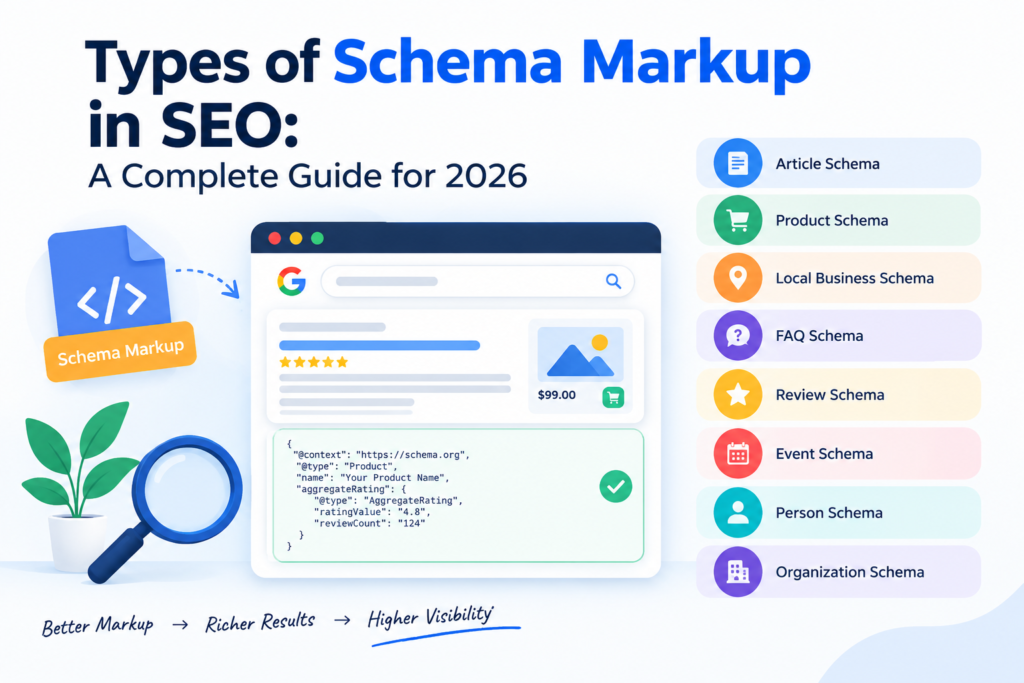
Search engines have become much smarter than before. Google can understand a website and its content without any extra help in many cases. But websites can still provide additional information to search engines through structured data.
One of the most common forms of structured data is Schema Markup.
Schema Markup helps search engines understand what a webpage is about and what type of information it contains. It can be used for articles, products, businesses, events, organisations, reviews and many other types of content.
For businesses working on SEO in Canada, understanding Schema Markup can be useful. A good SEO strategy is not only about keywords and backlinks. Technical SEO also plays an important role in helping search engines understand a website.
This guide explains the main types of Schema Markup in SEO, how they work, where they should be used and what businesses should know before adding them to their websites.
What Is Schema Markup in SEO?
Schema Markup is a form of structured data added to a webpage. It gives search engines more information about the content on that page.
For example, imagine a website has a page about a digital marketing service.
A search engine can read the page and understand that it contains information about digital marketing. Schema can provide additional structured information that identifies the page as a service and describes the organisation offering that service.
Schema Markup is generally implemented using Schema.org vocabulary. Google supports structured data in several formats and recommends JSON-LD for most structured-data implementations.
In simple words:
Schema Markup helps search engines understand the meaning and type of your content.
It is mainly a technical SEO activity. It should support useful and accurate content rather than being used only to try to manipulate search results.
Why Is Schema Markup Important for SEO?
Search engines need to understand the information available on websites.
Consider a page containing:
“ROIExpert”
“Digital Marketing Services”
“SEO Services”
“Canada”
“Blog”
“Contact”
A search engine can read these words. But structured data can provide additional context about what certain information represents.
For example:
- This is an organisation
- This is an article
- This is a service
- This is a product
- This is an event
- This is a breadcrumb
- This is a person profile
This additional context can help search engines process the information on a webpage.
Google also uses structured data to understand page content and determine eligibility for certain search features. However, adding Schema does not guarantee that a rich result will appear.
Schema Markup vs Structured Data
These terms are often used together but they are not exactly the same.
Structured data is the general concept of providing information in a structured format so machines can understand it.
Schema.org provides a vocabulary for describing different types of information.
Schema Markup usually refers to implementing this vocabulary on a website.
So when SEO professionals talk about Schema Markup, they are usually talking about adding structured information using Schema.org.
How Does Schema Markup Work?
Schema Markup uses specific properties to describe information.
For example, an organisation schema can include information such as:
- Organisation name
- Website
- Logo
- Contact information
- Social profiles
- Other relevant properties
An Article schema can include:
- Article title
- Author
- Publication date
- Image
- Publisher
- Article description
The information is added to the webpage in a structured format.
Google can then process this information along with the visible content on the page.
The most common implementation method recommended by Google is JSON-LD.
Main Types of Schema Markup in SEO
There are many Schema.org types available. You should not use every type on every website.
The right Schema depends on the actual content and purpose of the webpage.
Here are some of the most useful types.
- Organization Schema
Organization Schema is used to provide information about an organisation.
It can be useful for companies, agencies, businesses and other organisations.
For example, a digital marketing company can use Organization Schema to provide relevant business information.
Common properties can include:
- Name
- URL
- Logo
- Contact information
- SameAs profiles
- Description
For a company such as ROIExpert, Organization Schema can help describe the business entity behind the website.
However, the information in the markup should match the information that is actually available on the website.
When Should You Use Organization Schema?
Use it when your website represents a company or organisation.
It is especially useful on the main organisation or business pages.
Do not add fake information just to increase the amount of structured data.
- LocalBusiness Schema
LocalBusiness Schema is designed for businesses that operate at a physical location or have a local service presence.
It can include information such as:
- Business name
- Address
- Phone number
- Opening hours
- URL
- Location
- Business type
This type of Schema can be useful for businesses targeting local customers.
For example, a Canadian business serving customers in a specific service area may benefit from relevant local business structured data if it meets Google’s requirements.
But a company should not add LocalBusiness Schema simply because it wants to rank locally.
The business must actually qualify for the type being used.
For ROIExpert content targeting Canada as a country, there is no need to force a Canadian city into every page. LocalBusiness Schema should only be used when the business and page genuinely support local business information.
- Article Schema
Article Schema is designed for news articles, blog posts and other article content.
This can be useful for websites that publish regular SEO and digital marketing content.
Important properties may include:
- Headline
- Image
- Author
- Date published
- Date modified
- Publisher
- Main entity
For a blog about digital marketing, SEO or online advertising, Article Schema can help describe the page as an article.
Article Schema and SEO Blogs
If ROIExpert publishes a blog such as:
“What Is Zero-Click Search?”
the page can use appropriate Article structured data.
The markup should describe the actual article.
It should not contain information that is different from what users see on the page.
- BlogPosting Schema
BlogPosting is a more specific type related to Article.
It can be used for blog content.
For example, a digital marketing blog discussing SEO trends in Canada can use relevant BlogPosting structured data when appropriate.
Common information includes:
- Headline
- Author
- Publisher
- Date published
- Date modified
- Main image
The important thing is not simply choosing BlogPosting instead of Article.
The important thing is using accurate structured data that matches the page.
- Product Schema
Product Schema is mainly used on product pages.
For example, an e-commerce website selling clothing can use Product structured data.
It can describe:
- Product name
- Image
- Description
- Brand
- SKU
- Price
- Availability
- Offers
- Reviews where eligible
Product structured data can be especially useful for e-commerce businesses.
For example, if a Canadian online store sells sportswear, Product Schema can help search engines understand that a particular page represents a product.
Product Schema and E-Commerce SEO
Product pages should contain complete and accurate product information.
Schema should not be used to show information that users cannot find on the page.
For example, if the page does not actually offer a product for $50, the structured data should not say that the price is $50.
Accuracy is important.
- Review Schema
Review Schema is used for review-related information.
A review may be about:
- A product
- A service
- A business
- Another eligible subject
However, businesses should be careful with review structured data.
You should not create fake reviews or add reviews simply to get stars in Google.
Google has specific guidelines for review snippets and structured data.
If your website displays genuine reviews, make sure the markup accurately represents the visible content.
- AggregateRating Schema
AggregateRating describes an overall rating based on multiple ratings.
For example:
Rating: 4.8
Review count: 125
This information can be useful where it is genuinely available and eligible.
But businesses should never create ratings just to make search results look better.
If your website says that customers have given a 4.9 rating, the rating should be genuine and supported by visible information and a valid source.
Review and Rating Schema Are Not the Same
A Review represents an individual review.
AggregateRating represents a combined rating from multiple ratings.
Using the wrong type can create inaccurate structured data.
- BreadcrumbList Schema
Breadcrumb Schema helps search engines understand the structure of a website.
For example:
Home > Digital Marketing > SEO > SEO Services
This tells search engines how the page fits into the website structure.
Breadcrumbs can also make search results easier for users to understand.
BreadcrumbList is useful for websites with multiple categories and pages.
For larger websites, proper breadcrumb structure can make navigation easier for both users and search engines.
- WebSite Schema
WebSite Schema describes information about a website.
It can help search engines understand the overall website entity.
This is different from WebPage Schema.
WebSite refers to the website as a whole.
WebPage refers to an individual webpage.
For example:
Website: ROIExpert
Webpage: SEO Services in Canada
These are different entities even though they belong to the same website.
- WebPage Schema
WebPage Schema describes an individual webpage.
Different types of webpages can have different purposes.
For example:
- Homepage
- About page
- Service page
- Contact page
- Blog page
More specific WebPage subtypes can be used when appropriate.
The goal should be to describe the actual page rather than adding unnecessary Schema.
- Service Schema
Service structured data can describe a service offered by a business.
This can be useful for service-based businesses.
For example:
- SEO services
- PPC services
- Social media marketing
- Content marketing
- Web development
- Digital marketing services
For a website targeting Canadian customers, a service page could describe a specific service offered by the business.
A page about digital marketing services in Canada should clearly explain the service, target audience, benefits, process and other relevant information.
The Schema should support this information.
- Event Schema
Event Schema is designed for events.
Examples include:
- Conferences
- Workshops
- Webinars
- Training events
- Concerts
- Business events
Important information can include:
- Event name
- Date
- Time
- Location
- Event status
- Ticket information
Event structured data should only be used when the page actually represents an event.
- JobPosting Schema
JobPosting Schema is used for job vacancy pages.
A company advertising a genuine job position can provide relevant structured information.
For example:
- Job title
- Employer
- Job location
- Salary information where available
- Employment type
- Job description
- Application information
The job information should be accurate and up to date.
If a job is no longer available, the structured data and page should be updated accordingly.
- Course Schema
Course Schema can be useful for educational course pages where applicable.
For example:
- Digital marketing course
- SEO course
- Web development course
- Business course
The page should contain real course information.
A website should not use Course Schema simply because a blog discusses education.
The page needs to actually represent the relevant course information.
- Recipe Schema
Recipe Schema is designed for recipe content.
It can describe information such as:
- Recipe name
- Ingredients
- Cooking time
- Preparation time
- Image
- Nutrition information
- Rating
This is mainly useful for food websites and recipe blogs.
It is not relevant to most digital marketing websites.
- VideoObject Schema
VideoObject Schema describes video content.
If a webpage contains a useful video, structured data can provide information about that video.
Common properties include:
- Video name
- Description
- Thumbnail
- Upload date
- Duration
- Content URL where applicable
Video content can be part of modern content marketing strategies.
A company publishing educational videos about SEO or digital marketing can consider relevant VideoObject structured data.
- FAQPage Schema
FAQPage Schema is designed for pages containing frequently asked questions.
However, there is an important difference between using structured data and expecting a Google rich result.
Google has significantly limited FAQ rich results. According to Google’s documentation, FAQ rich results are generally shown for well-known authoritative government and health websites.
This means businesses should not add FAQ Schema simply because they expect FAQ rich results.
FAQs can still be useful for users.
You can create useful FAQ sections to answer real customer questions. Just do not treat FAQ Schema as a guaranteed ranking or rich-result technique.
- QAPage Schema
QAPage Schema is designed for pages where the main purpose is a question and answers provided by users.
It is different from a normal FAQ page.
For example, a community website where users ask questions and other users provide answers may be suitable for QAPage structured data.
A normal company FAQ page should not automatically use QAPage Schema.
- ProfilePage Schema
ProfilePage Schema can be used for pages representing an individual or organisation profile.
Examples can include:
- Author profile
- User profile
- Team member profile
For content websites, clear author information can also help users understand who created the content.
- DiscussionForumPosting Schema
DiscussionForumPosting is designed for forum or discussion content.
It can be relevant to websites where users create discussion posts.
This is different from a standard blog.
A company publishing normal articles should not use DiscussionForumPosting Schema simply because an article contains comments.
Schema Markup for an SEO and Digital Marketing Website
A digital marketing website usually does not need every Schema type.
A practical setup may include:
Organization
For the company or organisation.
WebSite
For the website.
WebPage
For individual pages.
Article or BlogPosting
For blog articles.
BreadcrumbList
For website navigation.
Service
For genuine service pages where applicable.
Person or ProfilePage
For genuine author or team profiles where appropriate.
Other Schema types should be added only when they match the actual content.
Which Schema Markup Is Best for ROIExpert?
For ROIExpert, the Schema strategy should depend on the type of page.
Homepage
Possible structured data can include:
- Organization
- WebSite
- WebPage
Service Page
Possible structured data can include:
- Organization
- WebPage
- Service
- BreadcrumbList
Blog Article
Possible structured data can include:
- Article
- BlogPosting
- Person or Organization for the author
- BreadcrumbList
- WebPage
About Page
Possible structured data can include:
- Organization
- WebPage
- BreadcrumbList
Contact Page
Possible structured data can include:
- Organization
- WebPage
- ContactPoint where appropriate
- BreadcrumbList
This approach is better than adding the same large Schema code to every page.
Schema Markup for Canadian SEO
Businesses targeting customers across Canada should focus on relevance rather than simply adding the word Canada to structured data.
For example, if a service page genuinely targets Canadian customers, the visible content should clearly explain that.
The page might discuss:
- Canadian businesses
- Canadian customers
- Search behaviour in Canada
- Digital marketing requirements
- SEO strategies
- Online competition
- Industry-specific needs
Keywords such as digital marketing agency in Canada, digital marketing services in Canada, digital marketing company in Canada and SEO agency in Canada can be used naturally where they match the search intent.
However, these keywords should not be placed inside Schema just for SEO.
Structured data should describe the actual page and business.
Does Schema Markup Improve Google Rankings?
This is one of the most common questions.
Schema Markup is not a direct ranking guarantee.
Adding Schema does not mean that a page will automatically move from position 10 to position 1.
Google uses many signals to understand and rank pages.
Structured data can help Google understand page content and can make pages eligible for certain search features when the requirements are met.
So Schema should be considered part of technical SEO rather than a shortcut to higher rankings.
Can Schema Increase Click Through Rate?
It can help in some situations when eligible structured data results in a richer search appearance.
For example, eligible product results can show useful product information.
Other structured-data features may provide additional information in search results.
But there is no guarantee that Google will display every piece of structured data.
This is why you should not measure Schema success only by whether a rich result appears.
The larger goal is to make your website easier for search engines to understand.
Common Schema Markup Mistakes
Schema can be useful but incorrect implementation can create problems.
Here are some common mistakes.
- Adding Schema That Does Not Match the Page
Do not mark a normal blog article as a product.
The structured data should describe the actual content.
- Adding Fake Reviews
Fake ratings and reviews should never be used.
They can damage trust and may violate search engine guidelines.
- Using Old Schema Recommendations
SEO changes regularly.
Some structured-data features that were useful several years ago may no longer generate the same Google search appearance.
Always check current Google documentation before implementing a new Schema type.
- Adding Too Much Schema
More Schema does not automatically mean better SEO.
Use relevant Schema.
Do not add every possible type to a webpage.
- Adding Information That Users Cannot See
Structured data should generally represent information that is available on the page and follows Google’s guidelines.
Do not use Schema to hide promotional claims or information that is not actually supported by the webpage.
- Not Updating Old Information
Suppose your business changes its:
- Name
- Website
- Address
- Service
- Price
- Event date
Your structured data should be reviewed and updated where necessary.
- Keyword Stuffing
Do not fill Schema properties with keywords.
For example, using:
“Best Cheap Professional Top Digital Marketing Agency SEO Company Canada”
as a company name would be incorrect.
Use the actual business name.
How to Add Schema Markup to a Website
There are different ways to implement structured data.
Method 1: JSON-LD
JSON-LD is the format Google recommends for structured data in most cases.
It is placed in the HTML of the webpage.
It can be easier to manage because the structured information is separated from the visible page content.
Method 2: Microdata
Microdata adds structured data directly around HTML elements.
It can work but may be more difficult to maintain on some websites.
Method 3: RDFa
RDFa is another method for adding structured information to HTML.
It is supported as a structured-data format but is less commonly used by many SEO teams compared with JSON-LD.
For most modern SEO implementations, JSON-LD is usually the practical choice.
How to Check Schema Markup
After adding Schema, do not assume that everything is correct.
Test it.
Google provides the Rich Results Test for checking whether a page may be eligible for supported rich results.
You should also monitor Search Console and review structured-data issues where applicable.
A good technical SEO process should include:
- Add relevant Schema
- Test the markup
- Fix errors
- Check warnings
- Validate the visible content
- Monitor Search Console
- Update when the page changes
Schema Errors vs Warnings
Not every warning means the page is broken.
An error may prevent a structured-data feature from being eligible.
A warning may indicate that additional information could improve the markup.
The exact impact depends on the Schema type and Google’s current requirements.
This is why SEO professionals should understand what each property means rather than simply trying to remove every warning.
Schema Markup and AI Search
Search is changing because of AI.
Google and other search platforms are increasingly providing direct answers and summaries.
This makes clear and well-structured website information more important.
Schema is not a special trick that guarantees visibility inside AI search.
However, accurate structured data can provide useful machine-readable information about a business, product, article or other entity.
A modern SEO strategy should therefore combine structured data with:
- Helpful content
- Strong website structure
- Clear entity information
- Good internal linking
- Technical SEO
- Quality backlinks
- Relevant keywords
- Strong user experience
Schema is one part of the overall system.
Schema Markup and Digital Marketing
Schema should not be treated as a separate activity that has nothing to do with marketing.
It supports the technical side of a wider digital marketing strategy.
For example, a digital marketing agency in Canada may use Schema as part of a client’s technical SEO work.
The complete strategy may also include:
- Keyword research
- SEO content
- Technical SEO
- Link building
- Local SEO
- Google Business Profile optimisation
- PPC
- Social media
- Conversion optimisation
- Analytics
- SEO reporting
This is why businesses should look at Schema as one part of a larger marketing plan.
Is Schema Markup Necessary for Every Website?
No.
Schema can be useful but not every website needs every type.
A small website with five pages may only need a few relevant types.
A large e-commerce website may need product-related structured data across thousands of pages.
A news website may use Article structured data.
A job website may use JobPosting.
A course website may use Course.
The right implementation depends on the website.
Schema Markup Checklist for SEO
Before publishing Schema, check the following:
- Does the Schema match the page?
- Is the information accurate?
- Is the information visible to users where required?
- Are the properties used correctly?
- Is the JSON-LD valid?
- Has the markup been tested?
- Are there any major errors?
- Does the Schema follow Google’s guidelines?
- Is the information still current?
- Does the page actually need this Schema?
If the answer is yes, the implementation is more likely to be useful.
Final Thoughts
Schema Markup is an important part of modern technical SEO.
It helps search engines understand different types of website content such as organisations, articles, products, services, events and other information.
But Schema is not a shortcut for ranking.
A website still needs useful content, good technical performance, relevant keywords, strong internal linking and a good overall SEO strategy.
For Canadian businesses, Schema can be included as part of a wider digital marketing strategy designed around search visibility and business goals.
If you are investing in SEO services in Canada, make sure your strategy includes technical SEO along with content, keyword research, website optimisation and performance tracking.
The best approach is simple:
Use Schema when it accurately describes the page.
Keep the information genuine and up to date.
Follow current search engine guidelines.
Do not use Schema only to manipulate search results.
For businesses looking for professional digital marketing services in Canada, technical SEO elements such as Schema Markup should be considered alongside the wider strategy.
ROIExpert focuses on connecting SEO work with real business outcomes. The aim should not only be better search visibility but also relevant traffic, qualified leads, conversions and measurable ROI.